
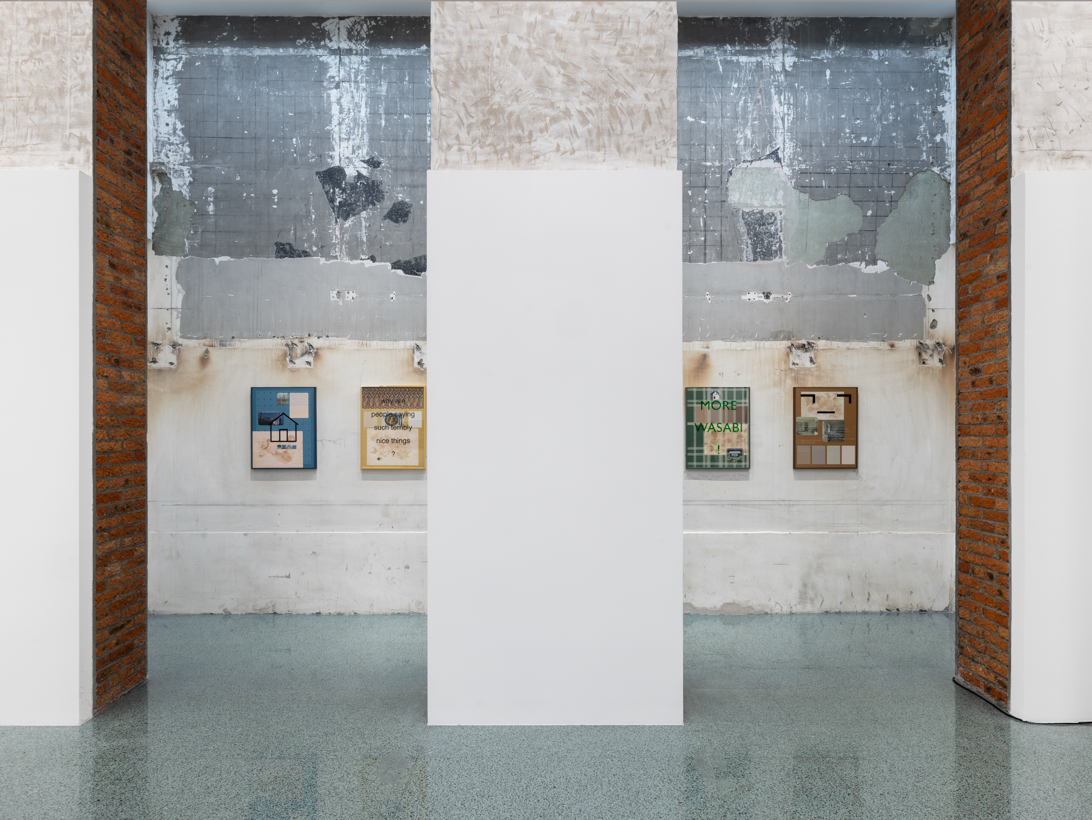
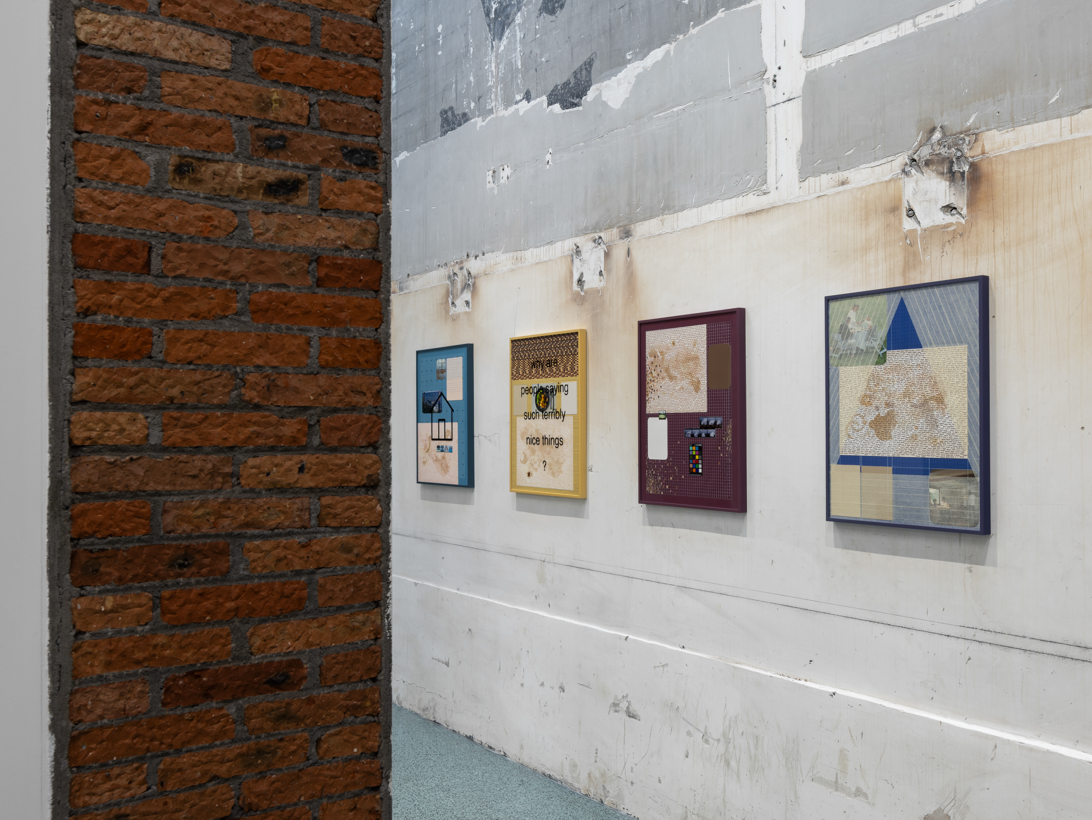
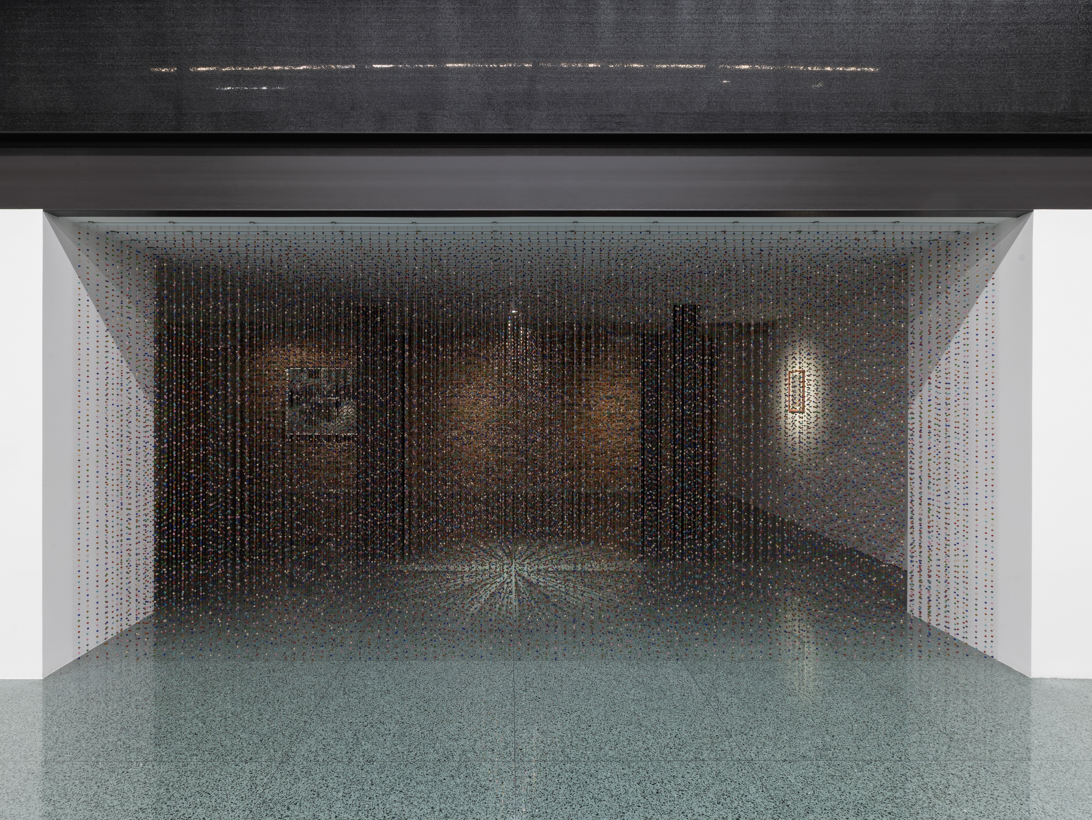
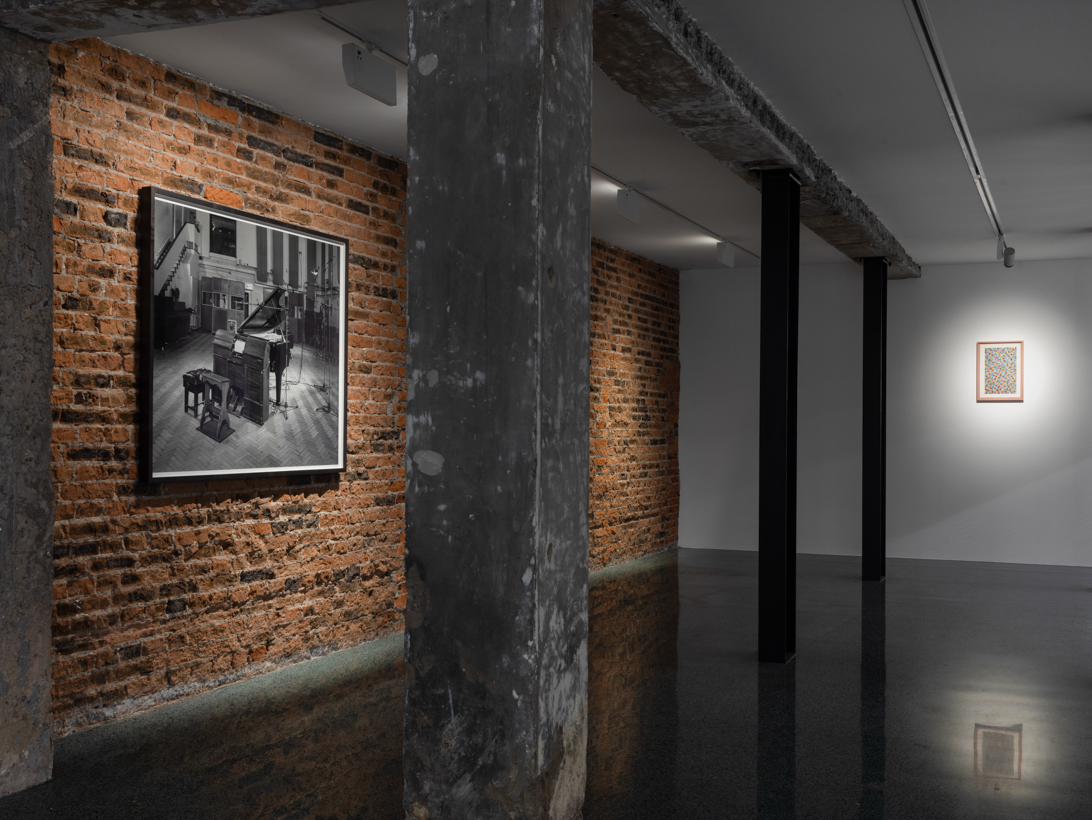
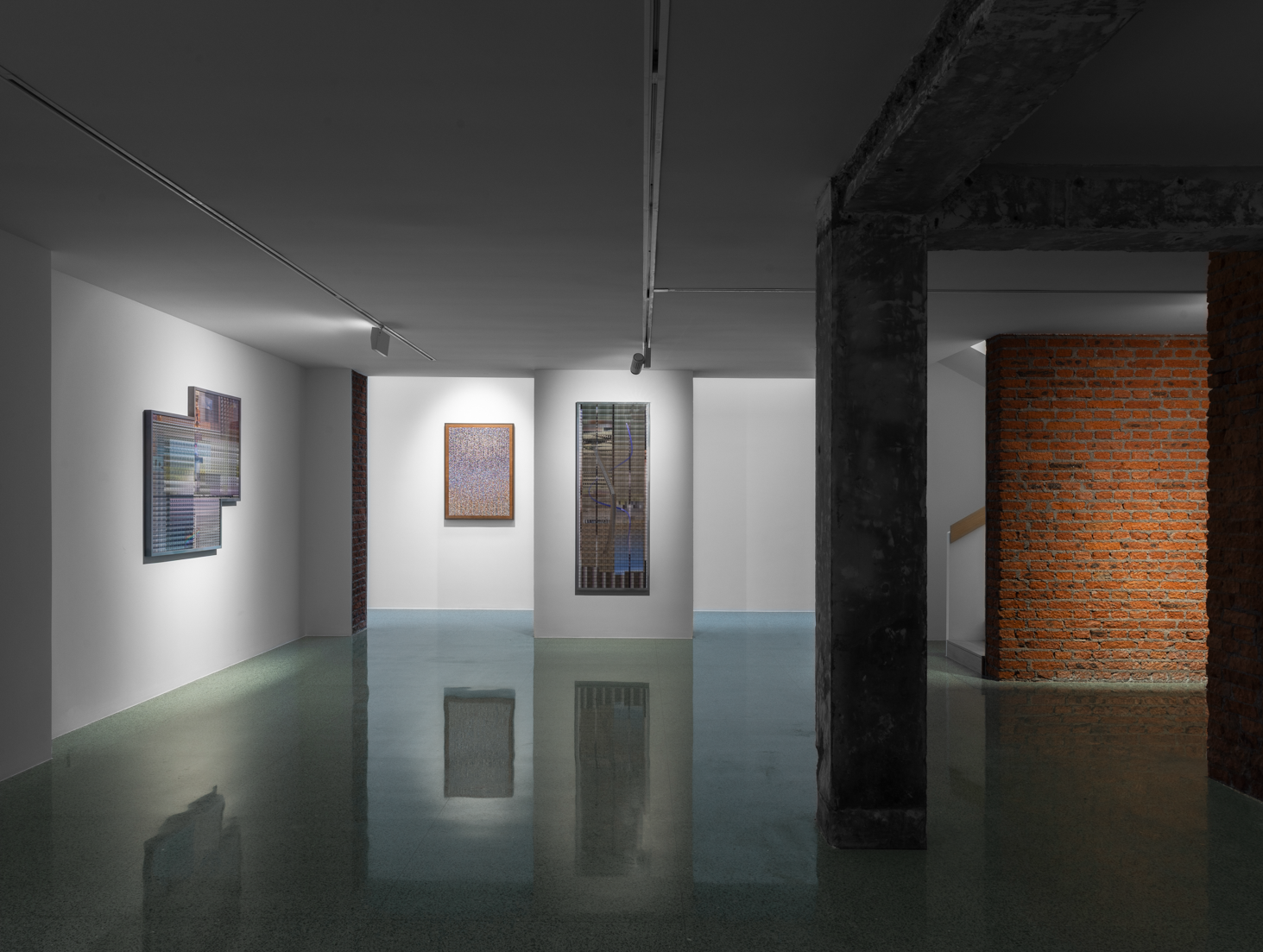
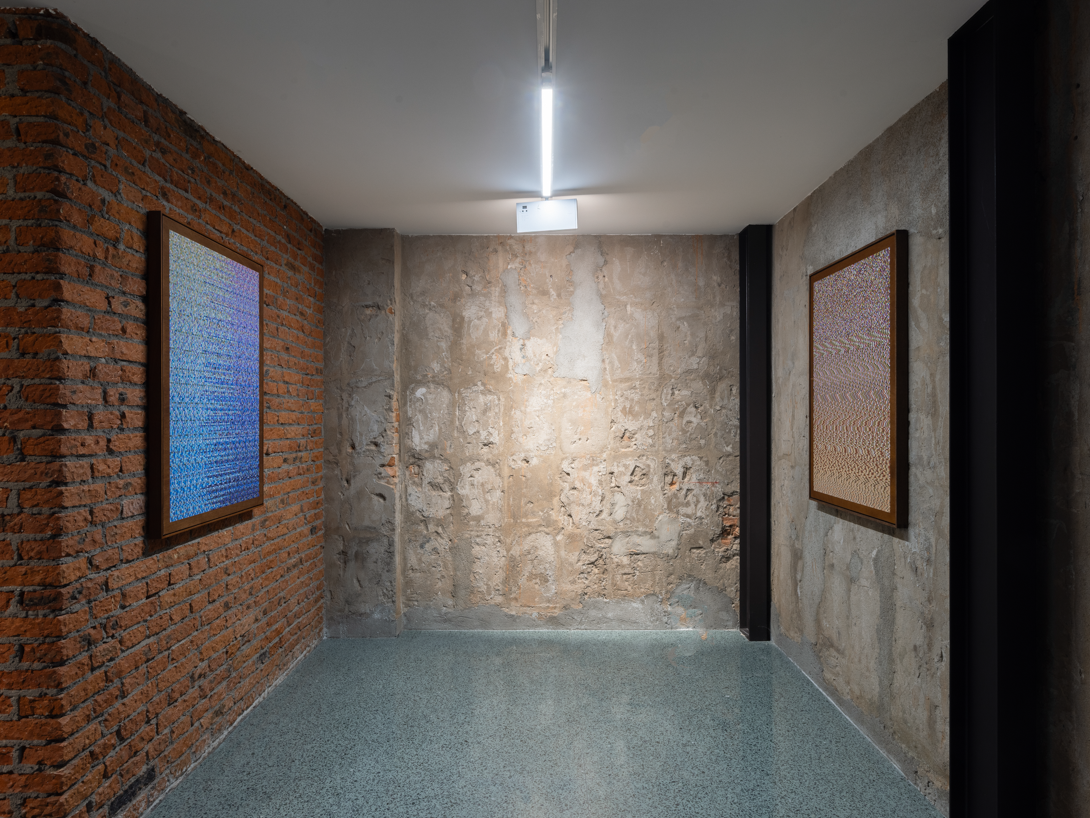
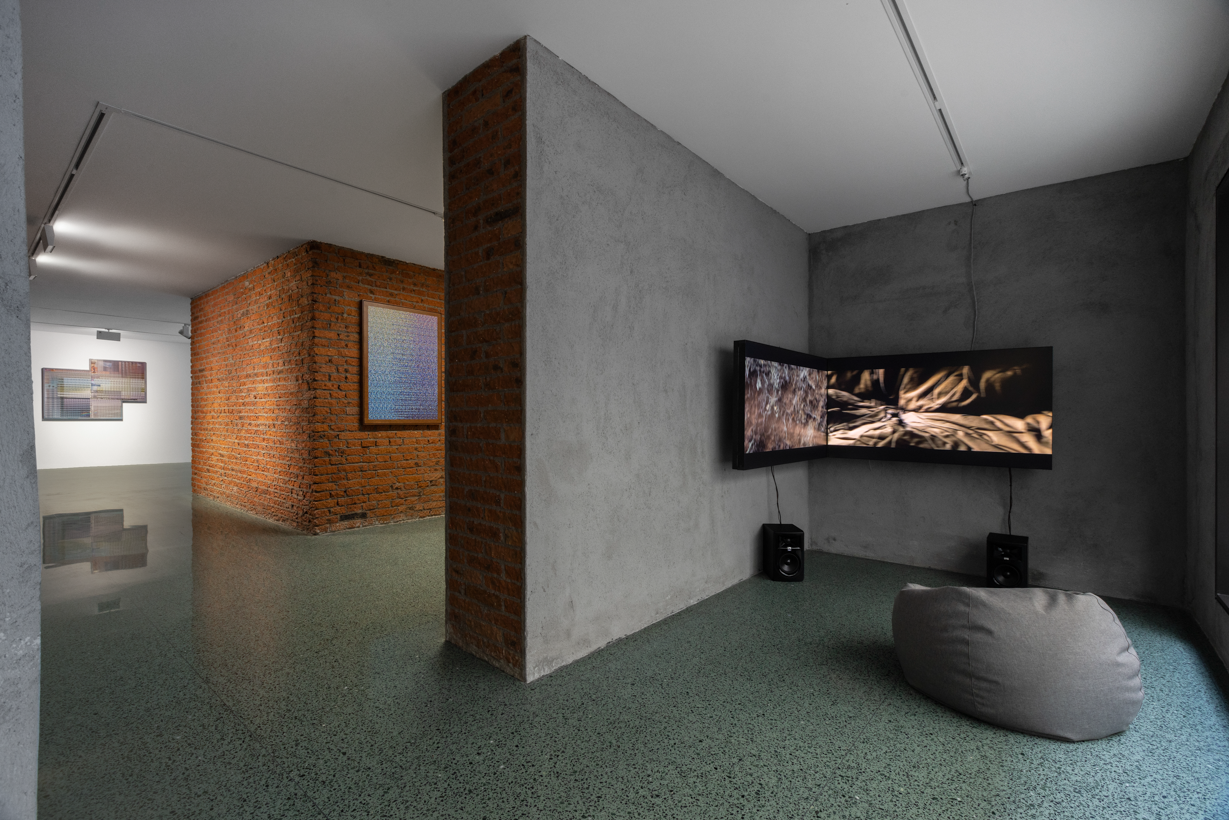
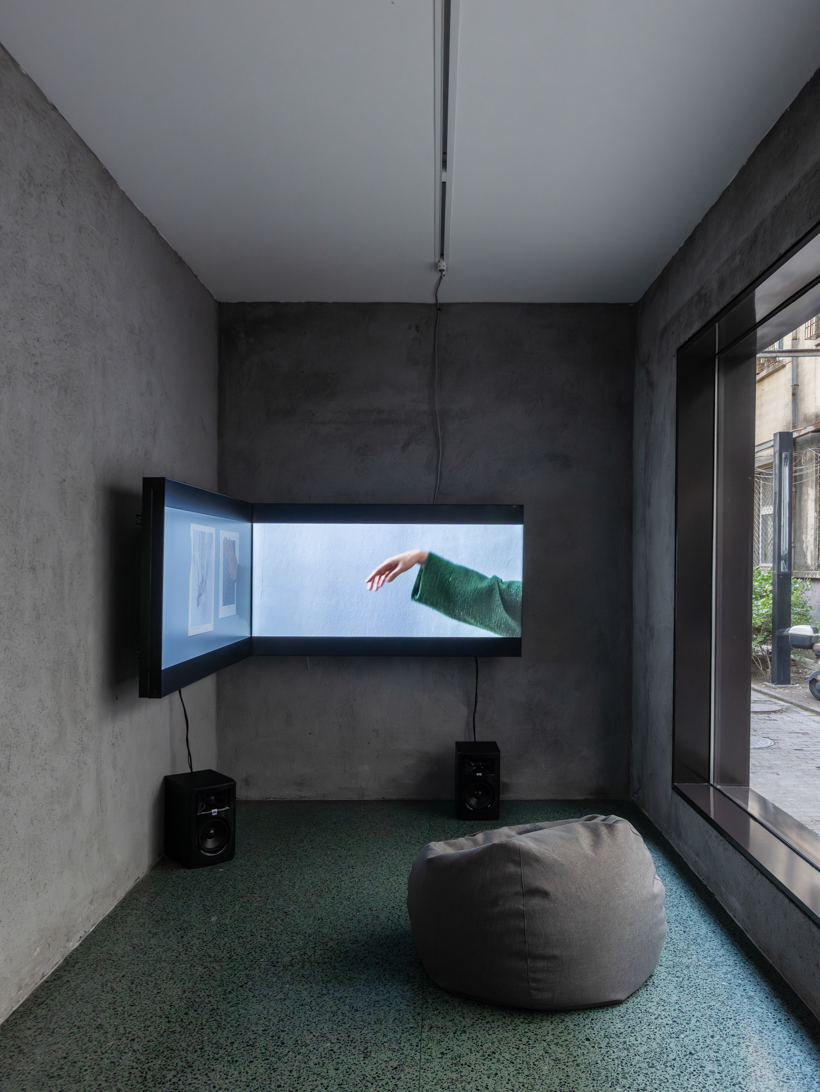
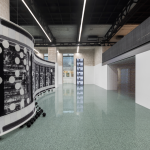
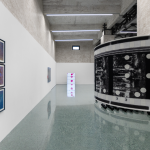
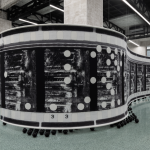
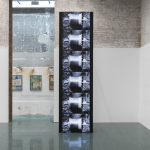
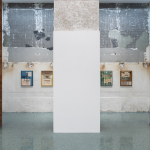
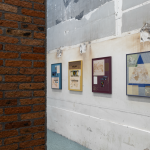
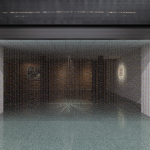
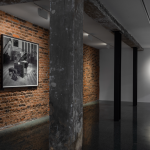
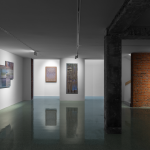
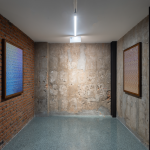
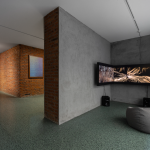
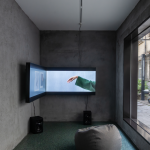
White Space is pleased to announce that the gallery has officially relocated to 798 Art District in Beijing. The new space, designed by designer and collector Tian Jun, has a total area of 1,150 square meters, and will open on October 30 with a two-person exhibition by Liu Shiyuan and Simon Starling.
“In October, Simon Starling and I flew from Copenhagen and landed in Beijing. Two people so alike, two immigrants in the Nordics, two foreigners on that land. I see the shared concerns in our work: labour that questions common values, respect for the visual image, reverence for image-making tools, and ways of working that both imitate and question mass production. The ‘dots’ in the exhibition take many forms: film grain, halftone dots in print, imperfect fruit, tiny pictures, 5 × 5 mm squares, burn marks on film, and stains left by coffee mugs or teacups.
Clusters form larger clusters, opening up endless possibilities. For me, the way images come together matters more and more than any single image. Images formed as the camera moves are interwoven, taking the viewer on a new journey and changing conventional ways of looking. Notions of geography and time are broken apart and reassembled in the viewer’s consciousness. (Who Was Hurting the Stones?)
Two video works with my hands as protagonists pull the viewer back into a more everyday context. Day after day, the time from sunrise to sunset grows unbelievably short. The female protagonist must use what little time she has to question meaning and value. She must uphold the conviction she draws from classic works of photography with her own life—a life that has endured spring, summer, autumn and winter. Thankfully, this is only a dream that’s already been dreamt. (Green Blanket Dream)
If the Beige series is a first attempt, Punished You and Me has been my repeated questioning, over the past seven years, of what I can do and what I should do.
I see the distance between the legendary and the nameless. The former takes shape as all visual images are translated into language in our minds. Thought governed by language changes how we see, and we in turn create new, subjective images. The latter lies beyond human manipulation: a world governed by a naturalness rooted in images, and one that emphasizes objectivity. It is like traditional farming that truly follows the laws of nature, built on the moon’s waxing and waning: at harvest time, we do not pick apples by hand from the tree, but pick up those that have already fallen. In this game we play no part. (Harvest)”
—— Liu Shiyuan
“A conversation across cultures and generations leads to an exhibition. The exhibition, in turn, creates a conversation between two very different bodies of work with numerous shared preoccupations.
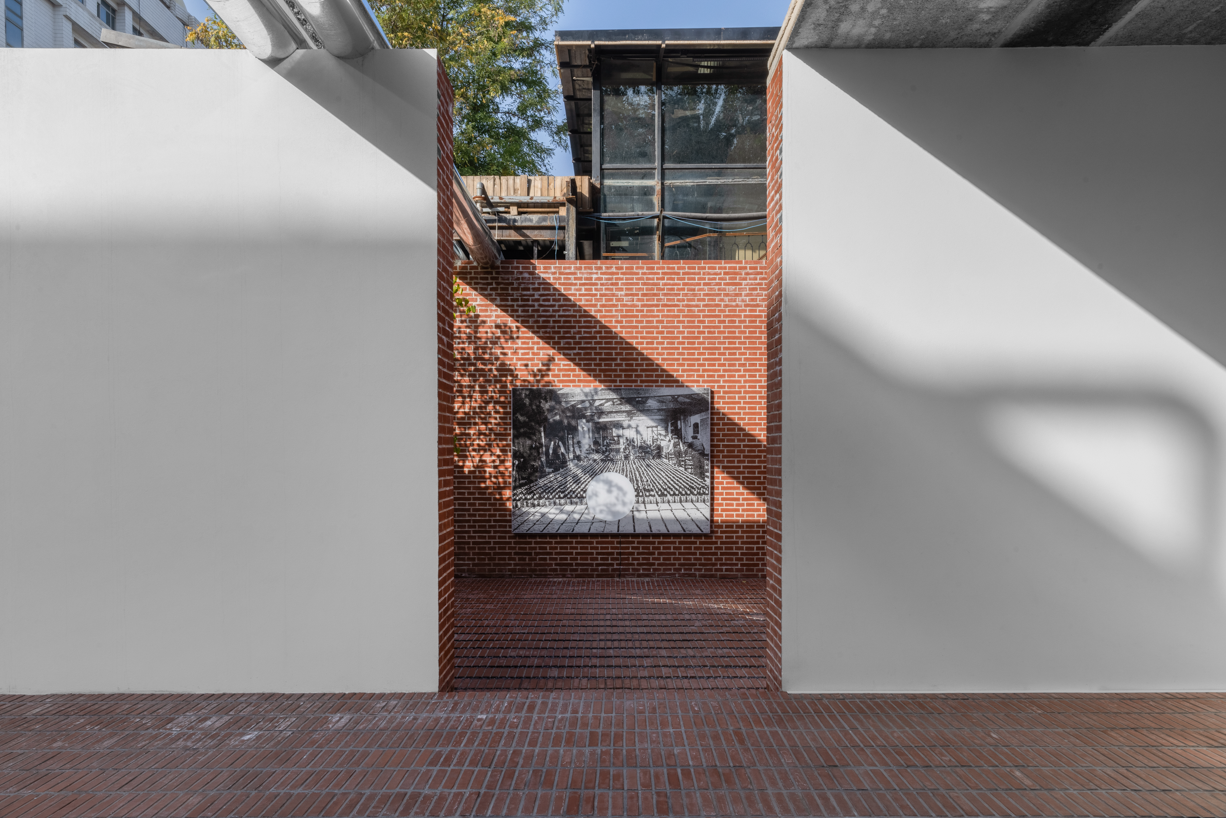
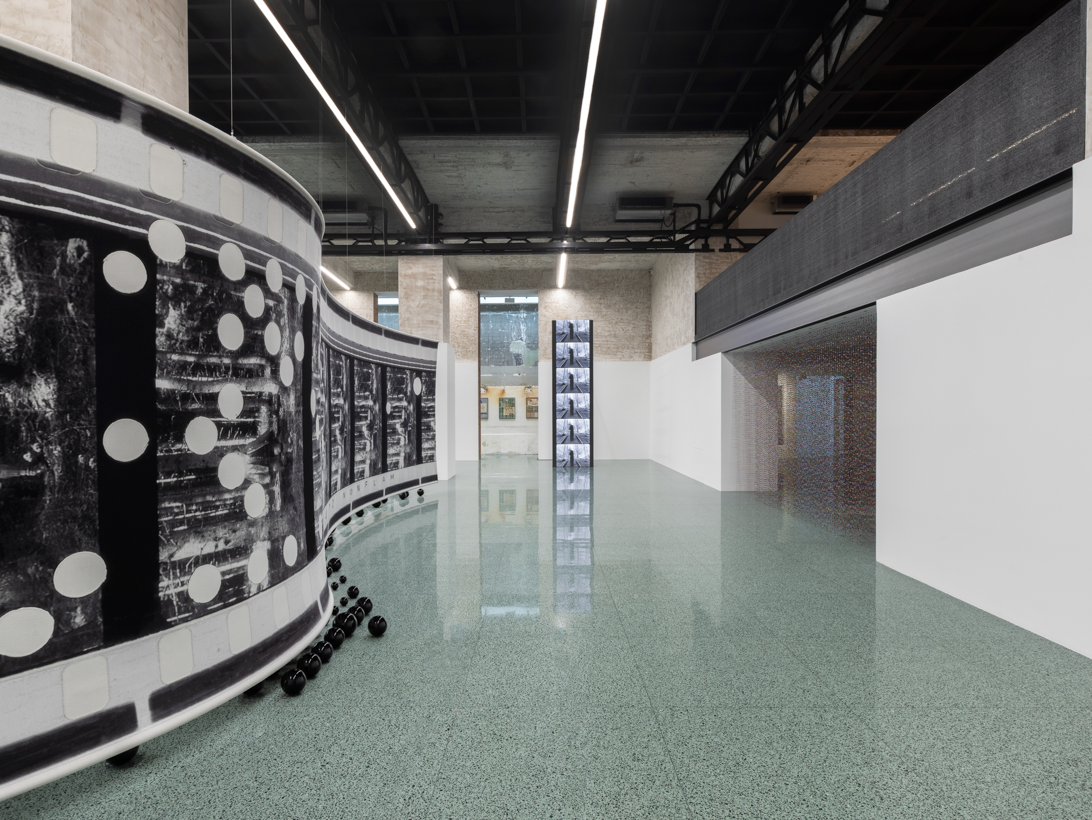
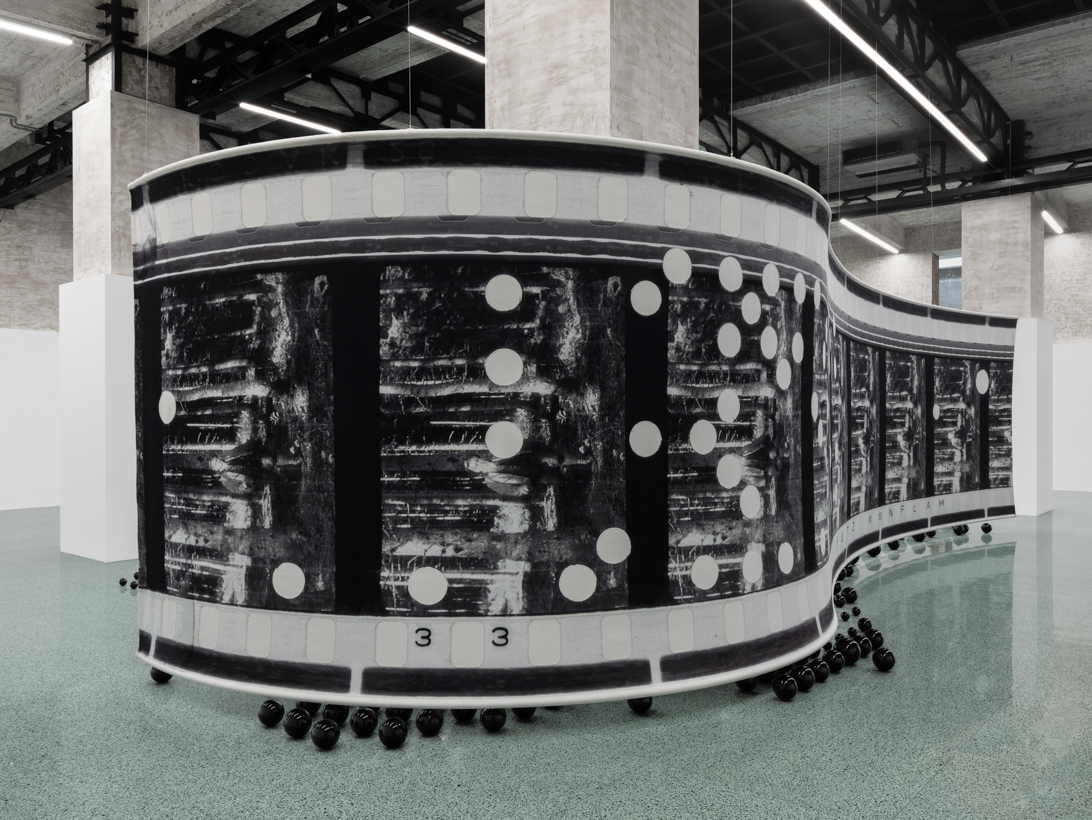
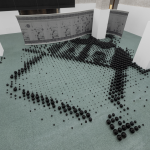
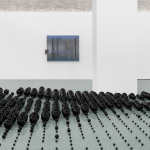
In this resolutely black and white array of works, two men in overalls unroll a drum of wire—one walking away from the other for 400 ft. A musician, for now absent, prepares to pedal his way through a largely unperforated, and thus silent, pianola roll. A man walks through a sun-dappled forest, his sinuous, woven path oddly punctuated by perforations. Workers at a mineral water bottling plant are caught in the dot matrix of a printed image as they arrange bottles in rows across the floor.
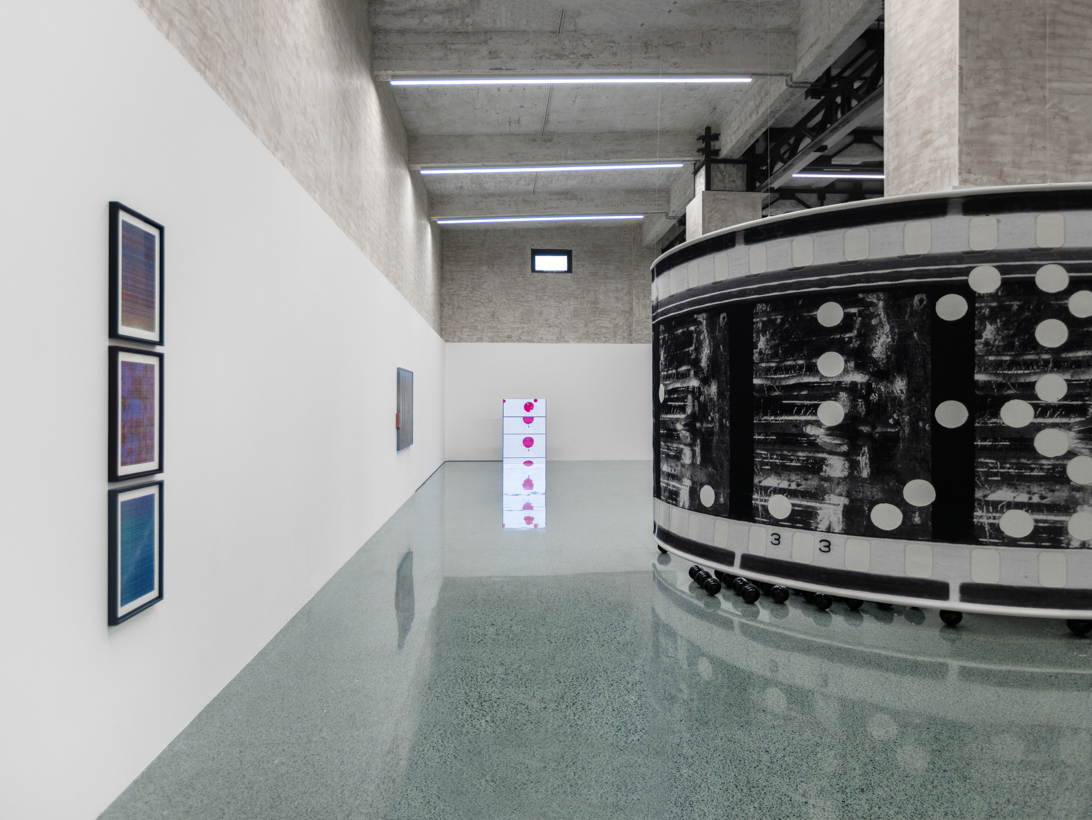
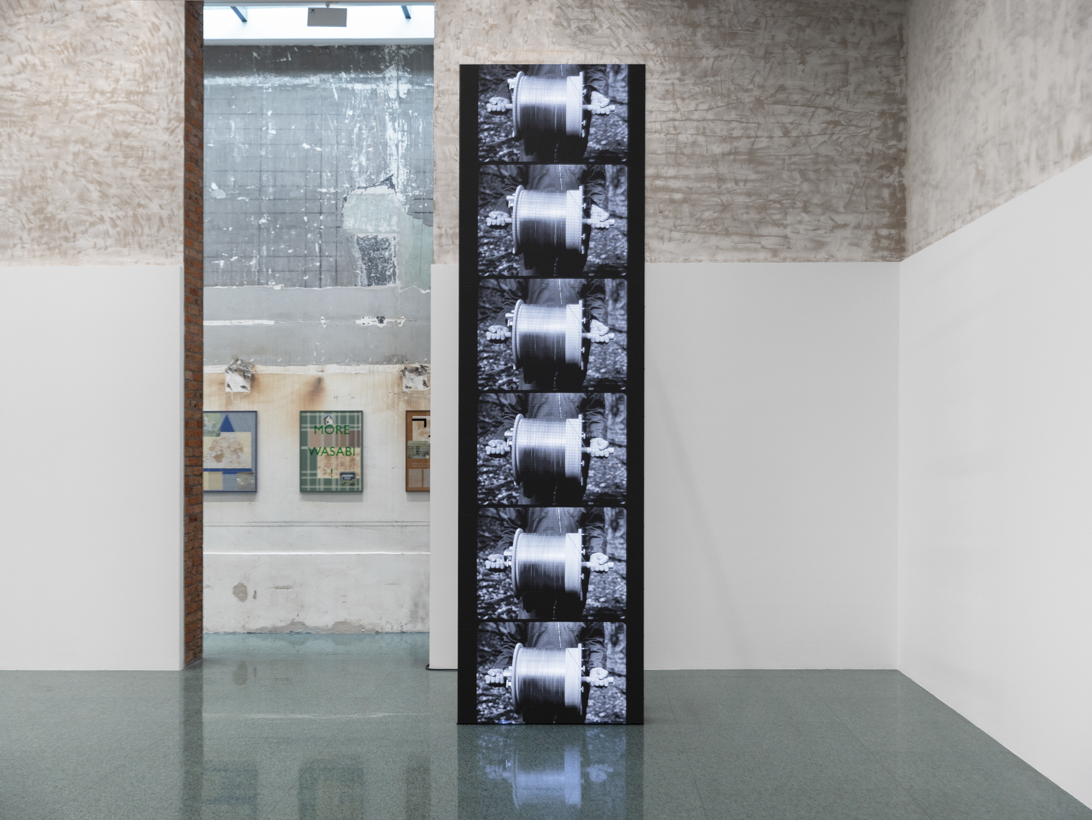
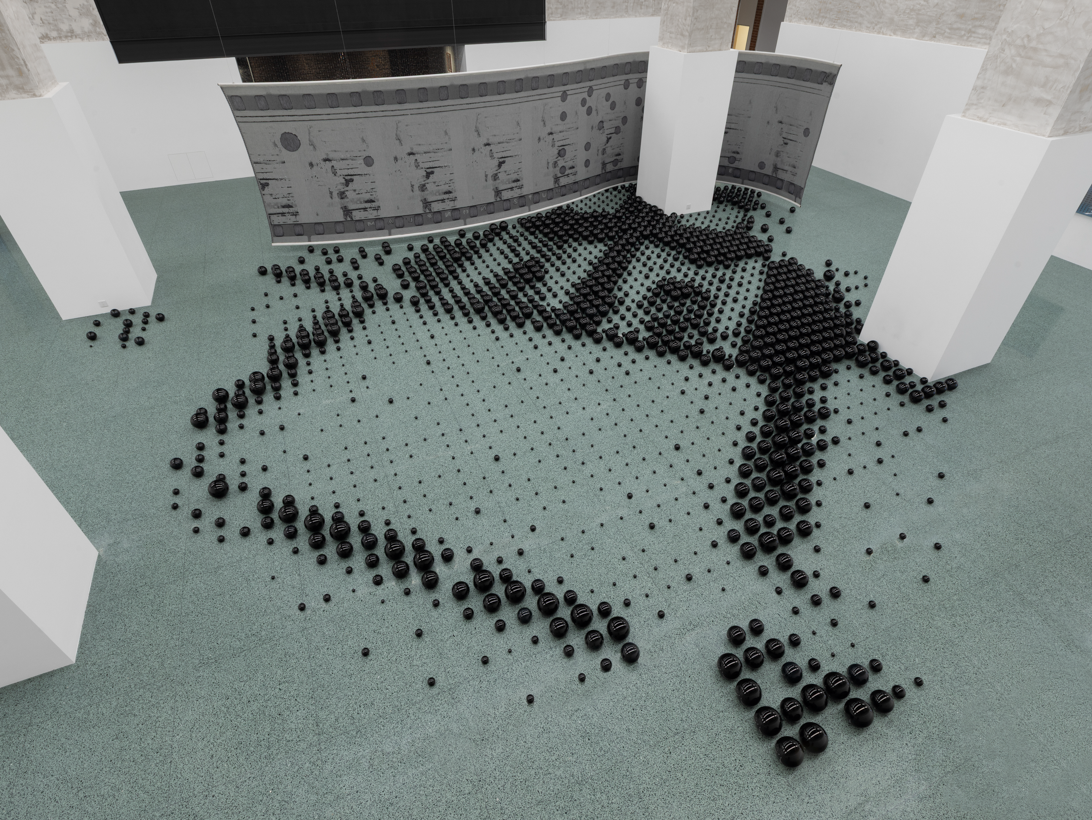
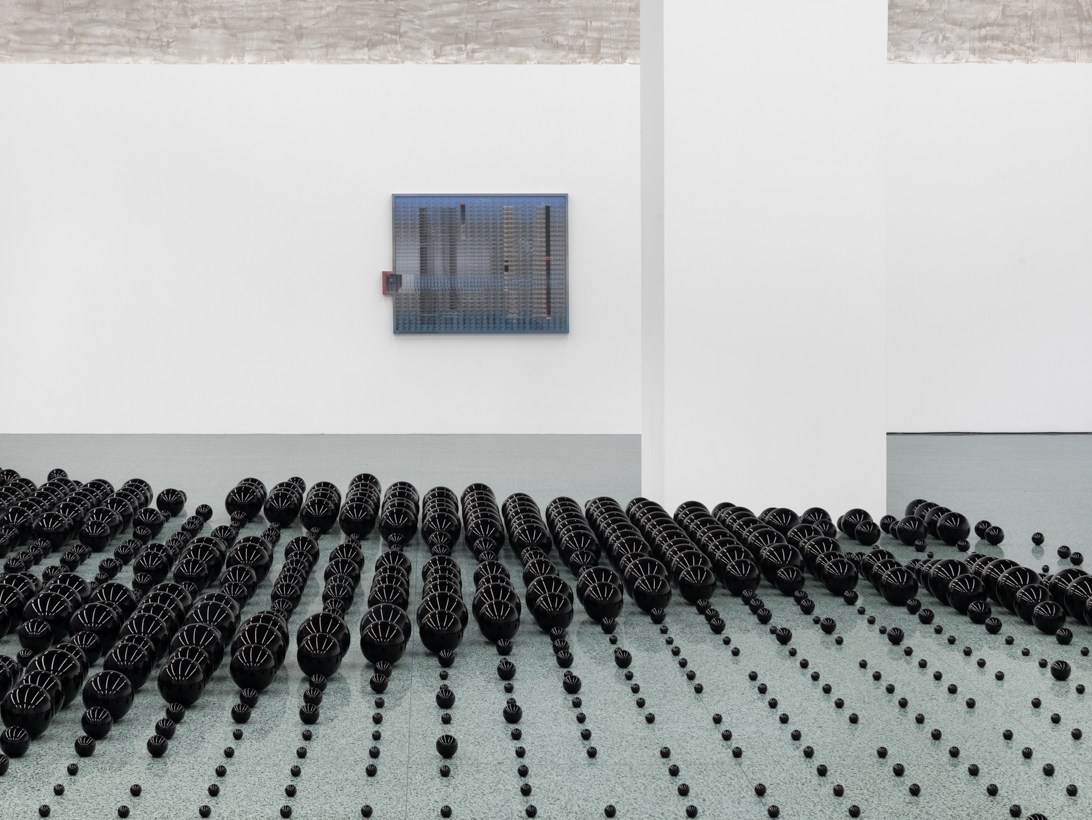
As we, the audience, negotiate this monochrome selection of works—a field of recorded actions—we reanimate it with our own movements. We track the film frames scrolling up an elongated video screen, torn between following the vertical movement of the frames and the horizontal actions they depict (Gauge). We zone in on the tiny perforated dots of the pianola’s paper roll; naming the composer, defining the duration, acknowledging the instrument (Rex Lawson Performs John Cage’s Composition 4’33″on an Aeolian Pianola, Abbey Road, London, 3rd of February, 2018 (Production Still)). We follow the movements of the man walking in the forest, step by step, along 13 metres of woven tapestry, one twenty-fifth of a second at a time (Walking, Computing). We tip-toe through variously sized, black glass balls—halftone dots that together reconstitute a fragment of an image of a factory floor—and climb stairs to find a vantage point and some form of resolution (La Source (Demi-teinte) / The Source (Halftone)).”
—— Simon Starling
About the Artist
Liu Shiyuan’s artistic practice spans many mediums, including photography, video, text, spatial installation, and stage plays. By eliminating preconceptions and subjective value judgments, Liu maintains a sensible and rational detachment toward the subjects in her works. Regardless of self-produced film and photography or images and cultural resources appropriated, Liu Shiyuan fully mobilizes and recontextualizes the suspended semantics of her objects, through which the artist asks questions about many aspects of the world recorded and engulfed in images, such as how images shape stereotypes, how they disseminate propaganda and the impact of pop culture on human perceptions and value standards. In a sense, be they pictures, texts, or physical objects, they are like actors to be directed and rehearsed by the artist to reactivate their original meaning and emotional potential and to construct new pictorial mazes, narrative puzzles, and intellectual theaters in their interaction with each other.
Liu Shiyuan (b. 1985, Beijing, China) received her BFA from the Digital Media Art Department of the Central Academy of Fine Arts, Beijing, China. In 2012 she graduated with a Master’s degree from the Photography Department of the School of Visual Arts, New York, USA. Recent solo and two-person exhibitions include CRISPR Whisper, Fotografiska, Shanghai, China (2024); Optimized Heart: David Douard / Liu Shiyuan, UCCA Dune, Qinhuangdao, China (2023); Suspended Frames, WHITE SPACE, Beijing, China (2022); For Jord, Tanya Bonakdar Gallery, Los Angeles, USA (2020); Opaque Pollination, Frost Art Museum, Florida International University, Miami, USA (2020); In Other Words, Please Be True, WHITE SPACE, Beijing, China (2019); Isolated Above, Connected Down, Tanya Bonakdar Gallery, New York, USA (2018); As Simple As Clay, Yuz Museum, Shanghai, China (2015). Recent group exhibitions include Mirror Image: A Transformation of Chinese Identity, Asia Society Museum, New York, USA (2022); NGV Triennial, National Gallery of Victoria, Melbourne, Australia (2020); The Mesh, Chi K11 Art Museum, Shanghai, China (2019); Lunar Phases, UCCA, Beijing, China (2019); Encounter, Shanghai Urban Space Art Season (SUSAS) 2019, Shanghai, China (2019); The Intertextuality of Art and Poetry, OCAT Shenzhen, Shenzhen, China (2019); Front international – Cleveland Triennial for Contemporary Art: An American City, Cleveland, USA (2018); Welcome to The Jungle, Kunsthalle Dusseldorf, Dusseldorf, Germany (2018); Cold Night, UCCA, Beijing, China (2017); Yinchuan Biennale-For An Image, Faster Than Light, MOCA Yin Chuan, Yin Chuan, China (2016); Bentu, Chinese artists in a time of turbulence and transformation, Fondation Louis Vuitton, Paris, France (2016); The 7th Shenzhen Sculpture Biennale, OCT-Contemporary Art Terminal, Shenzhen, China (2012). Liu Shiyuan currently lives and works in Beijing, China and Copenhagen, Denmark.
About the Artist
Simon Starling was born in 1967 in Epsom, UK. In 1977, he bought one second of one minute of one hour in a raffle and won his first camera. In 1980, he built his first home darkroom, and in 1992, he was awarded a Master of Fine Art from the Glasgow School of Art. Between 1993 and 1996, he served as a committee member at Transmission Gallery, Glasgow, and made his living photographing exhibitions in Scottish museums and galleries. In 1995, he held his first solo exhibition at the Showroom Gallery, London, for which he reconstructed part of the London exhibition space in Glasgow to use as a studio (An Eichbaum Pils Beer Can…).
In 1997, he built a small fishing boat in Marseille from a museum display case from the National Museum of Scotland, Edinburgh (Blue Boat Black), and made a chair out of a bicycle and a bicycle out of a chair (Work, Made-ready, Kunsthalle Bern). In 1998, following a trip to Ecuador to find a balsa tree, he flew a radio-controlled aeroplane over the Museum of Modern Art at Heide, Melbourne (Le Jardin Suspendu). In August 2002, he dug up a large Cereus cactus on the set of the Texas Hollywood Film Studio and transported it 2,145 kilometres to Frankfurt am Main, Germany, in a red Volvo 240 Estate (Kakteenhaus).
In 2003, as part of Zenomap, Scotland’s contribution to the Venice Biennale, he displayed an unwanted public artwork in the Palazzo Levi on the Grand Canal (Island for Weeds, Prototype). That same year, he began working as Professor of Fine Art at the Städelschule, Frankfurt. In 2004, he was shortlisted for the Hugo Boss Prize, and the following year, he won the Turner Prize. In 2008, he presented exhibitions at, among other places, a derelict bathhouse in Glasgow, Scotland (Project for a Public Sculpture (After Thomas Annan)); a semi-derelict factory in Dornbirn, Austria (Plant Room); and a fantastically narrow, seven-story house in Turin, Italy, known as the “Fetta di Polenta” (Slice of Polenta) (Three Birds, Seven Stories, Interpolations and Bifurcations). In 2011, Starling reinstalled more than 30 works from Camden Arts Centre’s exhibition history in the exact locations in which they had originally been shown (Never the Same River (Possible Futures, Probable Pasts)). He also conflated a sixteenth-century Japanese Noh play with the complex story surrounding the double life of Henry Moore’s sculpture Atom Piece (Project for a Masquerade (Hiroshima)). In 2013, he installed Phantom Ride in the Duveen Galleries at Tate Britain, London, and built a small black-and-white darkroom in his Copenhagen studio. In 2015, he used that darkroom to develop negatives made in twelve cities across North America and Europe, in an attempt to reconfigure two installation views of a 1927 exhibition of twenty-two sculptures by Constantin Brancusi at the Arts Club of Chicago (Pictures for an Exhibition). That same year, he began work on a play about W. B. Yeats’s 1916 foray into Noh theatre. The following year, At Twilight—a play within a play within a play, made in collaboration with theatre-maker Graham Eatough, choreographer Javier de Frutos, and musician Josh Abrams—was performed on an open-air stage in the garden of an Egyptianate villa in Glasgow. This full-scale theatrical performance was followed by an attempted crossing of the Dead Sea in a canoe made from magnesium extracted from Dead Sea water (Project for a Rift Valley Crossing). In 2017, with the help of a zampogna player, a kaval player, and a clog dancer, Starling imagined a possible encounter between three émigré musicians who had been photographed on Ellis Island, New York, at the beginning of the twentieth century (The Liminal Trio Plays the Golden Door). That same year, he presented an exhibition of four recent projects involving music at MRAC, Sérignan (À l’ombre du pin tordu). In 2019, while once again exhibiting Project for a Masquerade (Hiroshima) at the Aargauer Kunsthaus, Starling opened a two-part exhibition in Glasgow and Turin that conflated two masquerades of sorts: the dressing-up of a humble biblical story, The Finding of Moses, by the Venetian painter Giovanni Battista Tiepolo; and the dressing-down of the Fiat “supremo” Giovanni Agnelli, who, despite owning countless custom-made luxury vehicles, chose to drive an ordinary production car through the streets of Turin (A–A’, B–B’).