
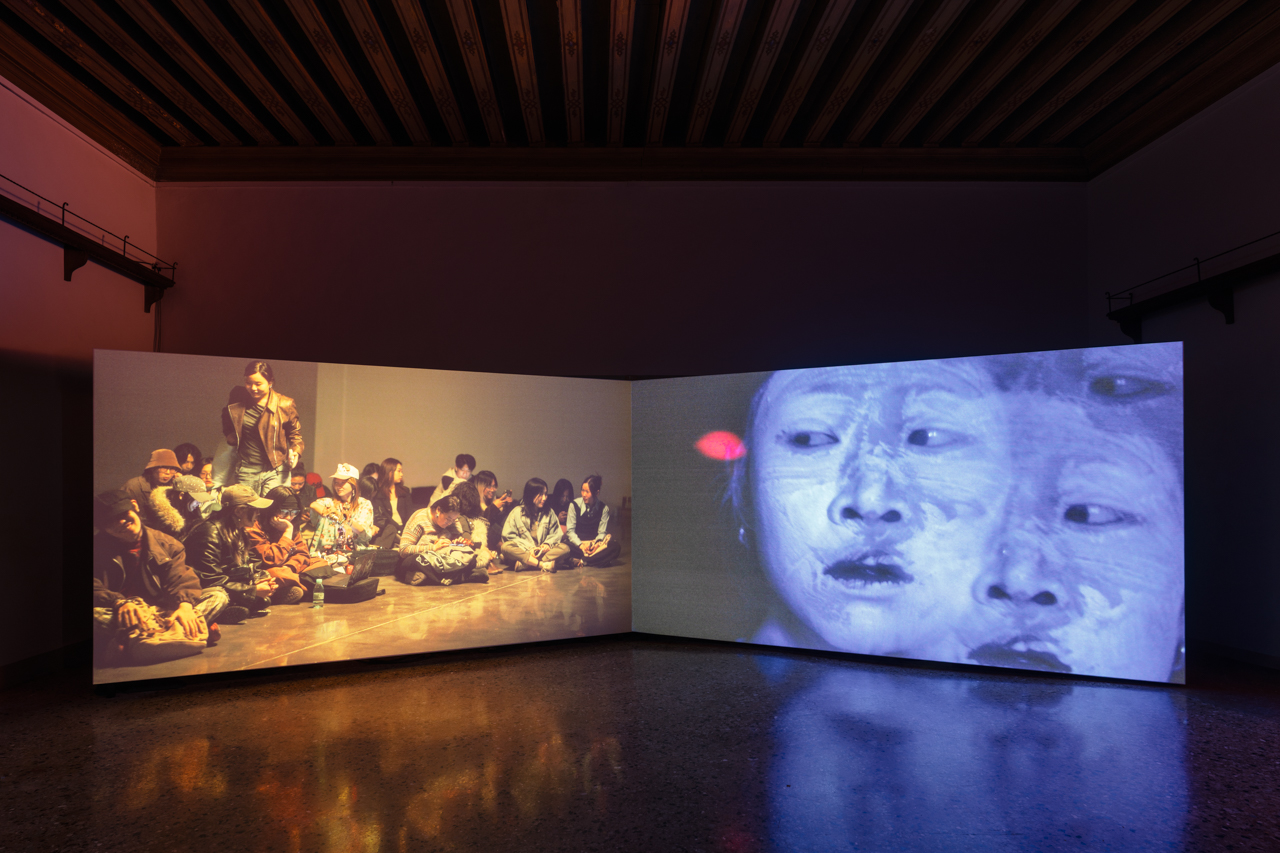
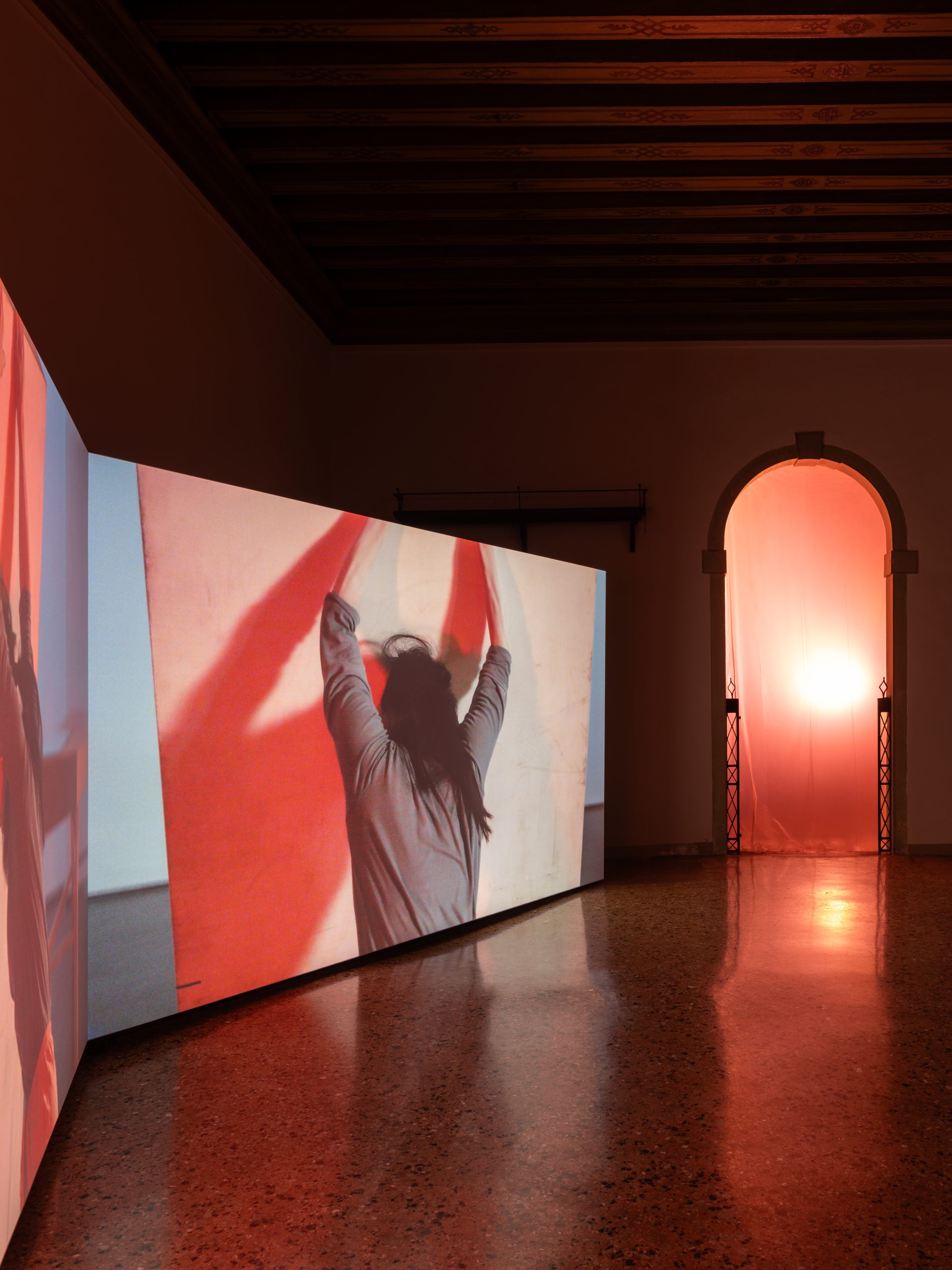
Canicula will premiere eight new site-specific video installations commissioned from Lawrence Abu Hamdan (1985, Jordan), Massimo D’Anolfi and Martina Parenti (1974, Italy/1972, Italy), Roman Khimei and Yarema Malashchuk (1992, Ukraine/1993, Ukraine), Janis Rafa (1984, Greece), P. Staff (1987, United Kingdom), Wang Tuo (1984, China), Yuyan Wang (1989, China), and Maya Watanabe (1983, Peru). All eight works are commissioned and produced by Fondazione In Between Art Film, the initiative conceived by Beatrice Bulgari to promote the culture of moving images and to support international artists, institutions, and theorists in their explorations of the dialogue between disciplines and time-based media.
‘Canicula,’ the Latin term that translates as ‘dog days,’ is widely used today to refer to the hottest days of summer, a period of the year that, in various ancient Mediterranean cultures, was associated with either great abundance or terrible ruin. The exhibition takes on the dazzling light and sweltering heat that characterise the dog days of summer as metaphors for the present day, a time saturated with excesses and distortions: extreme light and heat are thus considered to be the material and metaphorical frames within which matter, people and ideas are subject to immense pressure. The overload of images, the manipulation of information, the abuse of power, and oppressive temperatures are accelerating the approach of society – and, for that matter, of life on Earth itself – towards a critical threshold. Canicula places at the centre of the narrative the individual and collective responses to a landscape consumed by technology, eroded by inequalities and polluted by propaganda, exploring the psychological, political and social dimensions of the intolerable climate in which we are immersed. In this sense, mugginess and blinding light are subject to an expanded interpretation: on the one hand, heat is not just a force that is potentially damaging for bodies and for the environment but also a symbol of something that corrodes values, meanings and understandings; on the other, glaring light evokes the relentless contamination of truth by lies, and the ever-increasing perception of reality as a hallucination.
As had already been the case for Penumbra and Nebula, the scenography of Canicula, too, is designed by the multidisciplinary studio 2050+, which brings to life the exhibition narrative and the curatorial concept through a series of spatial and sensory interventions and through the use of materials that evoke
fatigue and deterioration.
As had already been the case for Penumbra and Nebula, the scenography of Canicula, too, is designed by the multidisciplinary studio 2050+, which brings to life the exhibition narrative and the curatorial concept through a series of spatial and sensory interventions and through the use of materials that evoke
fatigue and deterioration.